Texas PIDs
Public Improvement District Guide for Developers

Roads, water, wastewater and drainage projects are constructed long before lots sell to builders, funded with developer equity and acquisition and development (A&D) debt. That capital carries a financing cost the entire time it is outstanding. Meanwhile, interest accrues on the loan balance and private equity eats up returns until lots sell or homes close.
A Texas Public Improvement District (PID) changes that timing. It is not the right answer for every project, and it is not free money. But for the right project in the right jurisdiction, a PID can finance the construction or reimburse the developer for eligible public improvement costs at a tax-exempt rate early in the development cycle, thereby reducing overall financing costs and enhancing the returns to the developer.
This article covers what a PID is, how assessments and PID bonds function, and what a developer/builder should do prior to pursuing a PID.
What Is a Texas Public Improvement District?
The Public Improvement District Assessment Act (Subchapter A of Chapter 372 of the Texas Local Government Code), authorizes PIDs.
A city may create a PID within its corporate limits or within its extraterritorial jurisdiction (ETJ). A county may also create a PID, subject to a home-rule municipality’s ability to object within 30 days if the proposed district falls inside that municipality’s corporate limits or ETJ.
Two features set a PID apart from a utility district.
First, a PID is not a separate political subdivision. It has no elected board and no independent taxing authority. The city council or commissioners court that created the PID governs it. In turn, that same body is the developer’s counterparty on every term.
Second, a PID is created locally, not by a state agency. Unlike a municipal utility district (MUD), a water control and improvement district or a fresh water supply district, a PID is not subject to Texas Commission on Environmental Quality review. Instead, creation runs through the city council or commissioners court. However, PID bonds still require Attorney General approval before issuance.
How PIDs Function
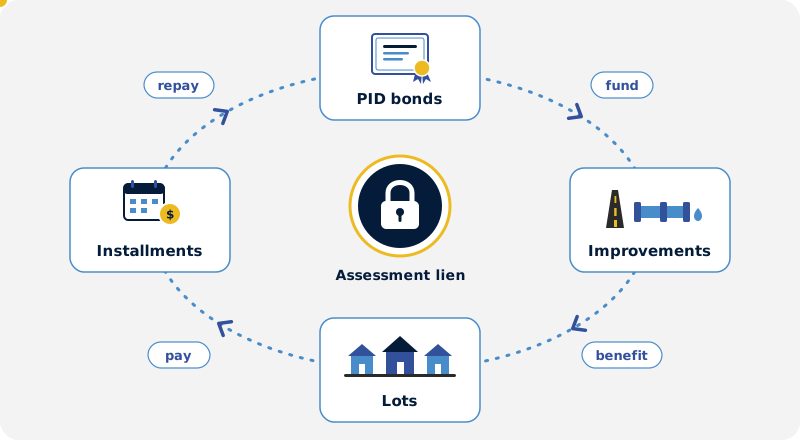
The Special Assessment
Costs inside a PID are recovered through special assessments levied against the property that receives a special benefit from the public improvements financed by the PID.
The governing body apportions the cost of a public improvement against property in the district based on the special benefit each property receives. Section 372.015 permits several assessment methodologies, including equally per front foot or square foot, according to value or any other method that imposes equal shares on similarly benefited property.
The statute lists permitted methods but does not choose one, so the developer and the city or county negotiate the method. In practice, the most common method is to spread the assessment based on assessed value. The method sets how much assessment each lot carries across improvement areas, lot types and phases. In addition, property owners may prepay an assessment in whole or in part at any time. A Service and Assessment Plan (SAP) documents the payment terms and identifies the improvements and their costs, the assessment methodology and the annual installment schedule. The governing body then adopts the SAP and must review and update it at least annually.
PID Bonds
Section 372.023 allows public improvement costs to be paid or reimbursed through several methods, and they are not mutually exclusive:
- A reimbursement agreement between the jurisdiction and the party that constructed the improvements;
- A temporary note or time warrant payable to that party;
- The issuance and sale of bonds under Section 372.024.
Chapter 372 allows the payee to assign a reimbursement agreement, note or time warrant without the jurisdiction’s consent. However, the specific agreement may still limit or condition assignment, so a developer that plans to sell, pledge or borrow against its reimbursement rights should negotiate those terms before signing.
PID bonds are payable from and secured by liens on revenue derived from the installment payments of special assessments and must not have a term longer than 40 years. A 30-year term is very common in practice. The bonds and the proceedings authorizing them go to the Texas Attorney General for examination. Once approved, the Comptroller registers them and they are incontestable.
The Assessment Lien
An assessment lien, with interest and collection costs, is a first and prior lien against the assessed property. It is superior to all other liens and claims except those for state, county, school district or municipal ad valorem taxes. It also runs with the land. Foreclosure, including foreclosure of a property tax lien, does not eliminate assessment installments that are not yet due, and a buyer at foreclosure takes the property subject to the assessment lien.
Sellers of property in a PID must also give purchasers a written notice required by Section 5.014 of the Texas Property Code. The notice tells the buyer that an assessment has been levied against the property, that it may be paid in full or in annual installments that vary from year to year and where to obtain the exact amounts. The requirement applies to anyone proposing to sell or convey real property in a district.
Why a Developer Evaluates a PID
The main benefit is timing. Earlier reimbursement changes the capital stack.
Getting reimbursed sooner can:
- Reduce the amount of developer equity tied up in the project
- Improve project cash flow and support capital recycling into the next phase
- Lower the project’s blended cost of capital, since tax-exempt bond proceeds typically cost less than private equity or A&D debt
- Improve internal rate of return by pulling reimbursement proceeds forward in the pro forma
- Support residual land value by lowering the net cost of delivering finished lots
- Allow the Developer more flexibility in planning, timing, and execution of a project
Ultimately, the size of the benefit depends on eligible costs, value, absorption, the assessment burden the market will bear and what the jurisdiction will approve.
Parties to the Transaction
The core parties to a PID transaction are listed below. However, only two of them represent the developer: the developer itself and its development finance advisor. A developer should bring a development finance advisor onto the financing team who represents only the developer’s interests. Launch Development Finance Advisors serves in that role.
Core Parties to a PID Transaction
| Party | Role | Whose interest they represent |
|---|---|---|
| Developer | Petitions for the district, builds the improvements, seeks reimbursement | Developer |
| City or county | Creates and governs the district, levies assessments, issues bonds | City/County (Issuer) |
| Bond counsel | Opines on validity and tax exemption | Issuer |
| Underwriter | Structures and sells the bonds | Underwriter/bond investors |
| Administrator | Prepares and updates the SAP, calculates annual assessments | Issuer |
| Appraiser/Market Consultant | Supports value assumptions | Underwriter/Issuer |
| Development finance advisor | Analyzes reimbursement strategies and bond issuance scenarios, tests the assessment burden, negotiates terms, supports Developer through formation and bond issuance, manages reimbursement | Developer |
Local PID Policy Matters More Than the Statute
Chapter 372 leaves most of the financial standards to the city or county. Value-to-lien standards, maximum assessment rates, target overall tax rates, community benefit requirements and application procedures are all set locally and vary widely.
Some cities have adopted detailed PID policies with financial tests and negotiated exhibits. Similarly, some counties run their own programs with separate application requirements. Other jurisdictions will not consider a PID at all. As a result, two otherwise identical projects on opposite sides of a municipal boundary can produce very different outcomes.
In short, local policy sets the limits on what a PID can deliver. For that reason, read the applicable local policy before committing to a structure. A later article in this series walks through the formation and financing process in detail.
Early Feasibility Considerations
Before spending meaningful time and resources pursuing a PID, a developer should be able to answer six questions.
- What public improvement costs are eligible for reimbursement? Eligible costs are the starting point for any bond sizing.
- What lot and home values will support the assessments, and when? Bonding capacity follows value and affects the amount and timing of bond proceeds.
- What is the total effective property tax and assessment burden on a home? If assessments push a home’s total tax rate above competing communities, the homes can be harder to sell.
- What does the jurisdiction’s PID policy require? Its financial tests and application requirements determine what the jurisdiction will approve.
- How is the project phased? Does the project require major improvements to be funded up front or can the project facilities be constructed on a phase-by-phase basis?
- What do the existing agreements already say? Development agreements and purchase contracts signed before the financing analysis may constrain financing.
Where Launch Fits
Launch Development Finance Advisors represents the private sector in matters of public infrastructure finance. Specifically, Launch works for developers, homebuilders and landowners. Launch does not represent the municipalities, districts or bond buyers on the other side of the table.
On a Texas PID, Launch’s work typically includes estimating bonding capacity, identifying and documenting eligible costs, testing the assessment burden against competitive projects, resolving value-to-lien constraints, preparing or reviewing assessment methodology, negotiating PID terms into development and financing agreements and managing reimbursement from cost tracking through payment.
Most of a PID’s value to the developer is decided when the development and financing agreements are negotiated.
Launch’s Texas PID Experience
Launch professionals assisted in the 2007 revision of the Texas Public Improvement District statute, which allowed developers to access PID bond proceeds to fund the public improvements they construct. In addition, Launch professionals were instrumental in the first PID bond issuance after the revised statute passed, for the Whisper Valley and Indian Hills transaction in Austin, in which the developer client funded engineering and construction costs out of bond proceeds.
More recently, Launch assisted with the successful closing of a 5.75% Special Assessment Revenue Bond for the Savannah Ranch Public Improvement District Improvement Area No. 1 on behalf of Toll Brothers. PID bond proceeds will reimburse Toll Brothers approximately $10.4 million in eligible public improvement and infrastructure costs at Clara Vista at Waterridge, an approximately 201-acre master-planned community near Kyle, Texas, expected to deliver 303 single-family homes at full build-out.
Frequently Asked Questions
Evaluate Your Project
A useful first step on any Texas project is understanding how much PID financing it could support. Launch prepares a complimentary bond sizing analysis using project-specific assumptions to estimate your project’s potential PID bonding capacity.