State Affordability Infrastructure Districts
Arizona Special District Formation in Months, Not Years
Arizona special district formation used to be measured in decades. We were on year 20 of establishing a Community Facilities District (CFD) in a southern Arizona community when HB 2999 passed. That bill created the State Affordability Infrastructure District, or SAID, and changed the timeline for landowners who need to finance public infrastructure.
Why Arizona Special District Formation Took So Long
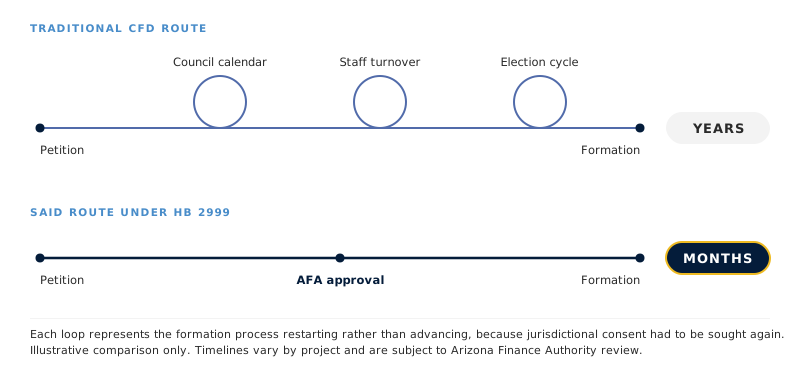
Under the traditional CFD process, a landowner needs jurisdictional consent. That means council agendas, staff turnover, policy changes, election cycles, and renegotiated terms. Every year of delay carries a cost: developer equity stays tied up in public improvements, lot delivery slips, and the reimbursement that supports project returns moves further out.
Twenty years is an extreme case. It is not an unfamiliar one.
What HB 2999 Changed
HB 2999 gives landowners the certainty to form a State Affordability Infrastructure District and finance eligible public infrastructure in months rather than years. A SAID requires approval from the Arizona Finance Authority (AFA). It does not require a city or county vote.
Removing the jurisdictional consent step removes the single largest source of schedule risk in Arizona special district formation.
How a SAID Finances Public Infrastructure
A SAID can issue three types of bonds to finance eligible public infrastructure:
- Limited tax general obligation bonds, secured by a district property tax
- Special assessment bonds, secured by an assessment lien on the land
- Revenue bonds, secured by fees or charges paid to the district
All three are tax-exempt, non-recourse to the developer, and carry a maximum 30-year term. Bonds may be issued before lots are sold or homes are built, subject to project specifics and AFA review.
For a developer, that combination affects the pro forma directly. Tax-exempt pricing lowers the cost of capital on the infrastructure component. Non-recourse structure keeps the obligation off the balance sheet. Earlier issuance returns capital sooner and frees equity for the next phase.
Three Landowners Govern the District
Three landowners make up the governing board of the SAID. A board composed of the people with capital in the project moves faster on formation, bond authorization, and issuance than a board that answers to a separate political calendar.
The Arizona DASH Program
Forming a district is one thing. Financing and administering it is another, and it requires a financial advisor, bond counsel, an underwriter, and a district manager working on the same schedule.
The Arizona DASH Program assembles that team under one engagement. DASH brings together the district finance and management advisor (Launch), bond counsel, the underwriter (D.A. Davidson & Co.), and the district manager (Blackwood Advisors), so a landowner reaches SAID formation, bond issuance, and ongoing district administration through one call rather than four separate procurements.
Each member of the DASH team played a direct role in shaping Arizona’s SAID legislation. They did not learn the program after it passed. They helped build it.